Almost six months ago I dyed some yarn. It was a 4-ply/fingering weight yarn made from 2 plies of Blue Faced Leicester. It was the first yarn I had ever dyed and I didn't know what to do with it. Then I discovered a really great pattern by Susan Ashcroft, That Nice Stitch. It's a free pattern on Ravelry and it's for a cowl. The textured stitch pattern, used in the cowl, is the same as is used in Susan's g'day boomerang shawl pattern, which isn't free. I saw the pattern and realised it would be a perfect way of using up my first endeavour in dyeing!
The stitch is interesting enough to make you think occasionally but not too difficult, which means it's perfect TV or podcast knitting.
As you can see, the cowl is knit on a bias, after using a provisional cast on. Once you reach the end of your yarn, or reach your desired length, you graft the two sets of live stitches together. I used up all 350m of the yarn I had.
I used, as always, the Wise Hilda Condensed instructions for grafting. I can never remember how to start a Kitchener! You'd think after doing them quite regularly for several years it would be embedded in the brain by now, but apparently not.
I chose to make the cowl a little wider than the pattern recommended, by casting on 60 stitches. I really liked the size of the Foolproof Cowl I knit and decided that I would try and make this cowl a similar size.
My estimating stitch counts paid off and the cowl loops twice round my neck nicely without being too close to my throat. If left as a single loop it covers a lot of my upper torso, which I find nice and warming when it's slightly cool, but not cold enough to add a full shawl or cardigan.
I really couldn't be happier with the combination of pattern and yarn. I'm quite proud of myself for dyeing the yarn in the first place, but it has worked out brilliantly in this knitted form. After knitting this fun cowl, I can imagine myself knitting the shawl version, maybe in some handspun yarn, or another hand dyed skein.
Now I've used my last skein of hand dyed yarn, surely that means I'm allowed to dye up some more, right?
Showing posts with label Dyeing. Show all posts
Tuesday, 8 July 2014
Tuesday, 11 February 2014
Spinning & Dyeing Yarn - Book Review
Today on my usual day about spinning, I wanted to show you my newly finished fluffy Polwarth yarn. Sadly, the light is terrible so I'm not even going to try and take photos of it. Luckily I have something else spinning related to talk to you about today. I recently received a package from the UK publisher of a new book. It contained Spinning & Dyeing Yarn by Ashley Martineau, to review. As with all the reviews I do on this site, I will give my full and honest opinion, and though I received the book without charge, there was no obligation on me to give anything other than my usual style of review.
The book itself is a very lovely thing. It is hardback book with bucket-loads of clear photographs and beautiful paper. (I do like it when books have nice thick and glossy paper, don't you?) The contents of the book are divided into four sections; Section One - Fibre Identification and Preparation, Section Two - Dyeing Techniques, Section Three - Spinning Techniques and Section Four - Going Professional. Each section is subdivided into chapters and the contents pages at the front of the book clearly list the various items discussed in the books and gives page numbers. There is also a nice clear index at the back of the book, so between that and the contents pages you should be able to find the things you want to look up, easily.
One of my favourite things about this book are the sections that deal with making your own equipment, including a spinning wheel! It gives good photos and explanations about what each type of equipment is and how it is used, and then gives tutorials about how to make versions of the equipment at home. Obviously not all equipment is easily made, but where it is possible, tutorials are given. This is great if you are just thinking about having a go with spinning. Most people don't want to spent lots of money on a new hobby, and this book will help them try new tools without spending vast quantities of money. To be honest, the spinning wheel looks pretty complicated and I think you would need to be handy with a saw and a drill, but if you brave crafter you may be tempted to give it a go.
I like the small sections, throughout the book, where people who work in the fibre industry are interviewed about their work. For example, a shepherd is interviewed in relation to buying fleeces direct from the farm, which is in something most beginners probably wouldn't consider.Talking about the sheep and how you would process a raw fleece may give a reader confidence to give it a go.
The dyeing section was of particular interest to me as I have only just started my journey into this field. There are several different methods outlined, on how to dye different fibres and has techniques that I am interested in trying. I don't think I'll get much opportunity to try solar dyeing though as it requires several hours of strong direct sunlight. We don't get many good Summers in the UK, but it's worth thinking about if we get another Summer like last year.
One of my problems with the book is that though it is a great introduction to the world of fibre, it doesn't really give a good clear explanation of what drafting is, what it looks and feels like and how to do it. The only definition of drafting I have come across, before reading this book, were worsted and woollen. However, this book refers to woollen and aran drafting and states that woollen drafting feeds the fibre forwards into the twist and aran refers to having your front hand hold the twist and pulling the fibre backwards before letting the twist travel up by moving your front hand back, towards the back hand, controlling the twist as your hand travels.
I have not come across the term aran drafting, but of course, I am a beginner spinner so it may be that I've just not come across this term, because nearly all I've learnt of spinning has been from American publishing and websites. This version of the book has been published for a British audience, and the spellings make it obvious that they have changed terms for the UK, so it may be that in UK spinning guilds I would be taught these terms. I don't think a complete beginner could learn how to draft properly using only this book. A beginner would probably have to watch videos or read further tutorials to understand what they were doing.
The book really focuses on spinning with a wheel rather than a spindle, though it shows some techniques on a kick wheel. I think this may well be a route lots of new spinners take: trying to spin on a spindle, possibly using a home-made one, as in the tutorial in the book, deciding they like it and buying a wheel. The book then jumps straight to creating many different types of art yarns, which is what the book focuses on principally.
The sub-title of the book is The Home Spinner's Guide to Creating Traditional & Art Yarns. I think the "traditional" part of the title is over stating it somewhat. This book essentially focuses on getting a spinner to the stage where they create art yarn as quickly as possible. I feel like the middle step of learning to spin is missing from the book. It introduces basic equipment and then jumps to spinning art yarn on wheels. There is no middle ground where you learn to spin basic, consistent yarns in a way that the spinner decides. Because of this focus on art yarn, I wonder if the book would have been better served by excluding all the basic information at the beginning of the book and adding more to the latter parts of the book.
The final section of the book, relating to becoming a professional spinner, has several useful subjects, the first of which, relates to photography. It even shows you how to make a cheap lightbox to take photographs for a shop. However, even if you don't intend selling your yarn, this will be useful for any blogger, or someone wanting to take a good photographic record for listing your finished yarn on Ravelry.
There are several good tips about selling any crafted item, moving from a hobby into becoming professional, however, this area of the book doesn't go very far in depth. The resources section is very good, as the book has been re-published for the UK, so includes some UK resources as well as US ones. This is very useful information to have, if you looking at developing your hobby, even if you don't want to go professional.
In summary, I like this book. It has lots of interesting information that covers a broad range of information. I think there are many books that go in depth in a very specific area of creating yarn, but there are few that touch on so many subjects. It would be a good book for someone to use as an initial resource to give you starting point to find out if you want to go further in a specific area, and then go on to do more studying. It shows you what is possible with spinning and dyeing and inspires the reader to try different things.
The publishers of this book have very kindly offered a discount from the RRP of £25 to £20 including UK P&P. To order Spinning and Dyeing Yarn by Ashley Martineau for this reduced price, telephone 01903 828503 or email mailorders@lbsltd.co.uk, quoting the offer code APG73 and the book ISBN 9781909342460. The book is released in the UK on 20th February 2014.
Sunday, 19 January 2014
Hand Dyed Purple Sockhead Hat
After dyeing my last skein of yarn, the gloriously purple Blue Faced Leicester 4ply yarn, I decided that it would match incredibly well with one of my favourite shawl/scarfs, the Fluvial. As I had very itchy fingers for this yarn, I didn't even stop to think, and immediately cast on another Sockhead Hat. I love this pattern, it's simple to knit and the hat suits me really well, and gives me options on how warm I want my ears to be.
One thing I learnt from my last version of this pattern, is that I wanted the body of the hat to be shorter. Instead of knitting the stocking stitch portion of the hat to 9", I knit it to 7" before carrying out the decreases. This means the hat is almost beanie like when the brim is rolled back. It means the body of the hat isn't pulled tight, so it traps lots of air around the head to help keep me warm.
I adore this hat. The fabric is even and smooth and I didn't have to block it at all. I know that in future, if I get a chance to buy BFL yarn to dye again, I grab it with both hands. It dyes well, without there being too much risk of felting and it is a lovely yarn to knit with.
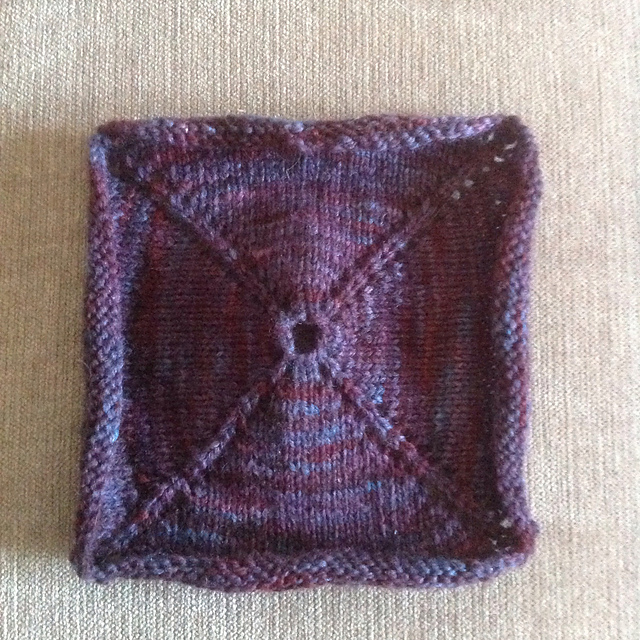
When I'd finished my hat, I had some of the yarn left over and I didn't want to waste any of it so I decided to add it to my "leftover sock yarn, which will be used one day, somehow" bag. This bag was initially intended to be used to make a Bee Keeper's Quilt, but after a few hexipuffs, I found it just didn't appeal to me as a long term project. The pile has threatened to topple over a few times, and when I added the scraps from this project to the pile, the bag tipped over. I decided it was a sign, and found a new project to use it. I'm doing the Sock Yarn Square by Shannon Geddes pattern, but instead of knitting into the back loop of the yarn over increases, I'm just leaving them open. I'm knitting 15 increase rounds to get a nice sized square and I'm using 2.75mm needles, and knitting with 2 circular needles.
I think this project will work better, for me, than the Bee Keeper's Quilt. I don't need another heavy blanket, I've already got a couple. What would be nice, is something lighter weight and these squares would form a light and pretty blanket. The pattern is straight forward and can be easily done while socialising. I think you will be seeing more of these squares than you did of the hexipuffs. In the meantime, I shall continue to enjoy my new hand-dyed hat!
Labels:
Complete,
Dyeing,
Hat,
Scrap Blanket
Friday, 10 January 2014
More Dyeing
After my last dyeing adventure I was very keen to have another go. A new bigger pyrex dish arrived (eventually, after some fun where the first one was lobbed over the 7' gate to my back garden by the delivery guy, and of course smashed). The dish I bought was the biggest I could find that would fit into my microwave and it has much more space to dye in, which makes it easier.
I decided I wanted some purple yarn so went heavy on the purple and red and added a dash of blue colouring. I might have gone a bit too heavy on the dye. It took eons to rinse the yarn as there was so much left over after the yarn was saturated. I learnt that I really don't need very much of the Wilton's Gel. The resulting yarn, however, was amazing. I was so happy with it.
I also really love this yarn base. I may have to order some more BFL yarn because it resisted felting really well, despite all the rinsing that was required. On the same day, that I dyed this, I decided that I would try dyeing some of the Superwash Merino fibre I bought. I wanted to try a completely different colour scheme, so went with the cream and yellow colours. I mixed it throroughly together and used a lot less of the colour. I added the soaked fibre to the mixed dye and then when it had absorbed the yellow dye, I added a couple of splashes of green to the top.
I love the vibrancy of this fibre. The fibre is still amazingly soft, which I was not expecting, for some reason. I would never buy this sort of coloured fibre normally. I normally only buy my absolute favourite colours of fibre, which means there isn't much variety in my fibre. Dyeing the fibre myself is giving me free rein to choose different colours to my normal top of the list choices. I've started spinning it already because it is perfectly sunny for the currently grey weather.
I'm using my brand new Enid Ashcroft Bocote spindle that I managed to score on an ETSY update.
I was amazed that I managed to find this spindle because it is meant to be quite difficult to find the updates for this maker, as they are not frequent and the quality is meant to be excellent. I just stumbled over the spindle when I was browsing supported spindles on ETSY and when I saw this for sale, I knew it was meant to be mine! It is amazing. It spins like a dream. The sample above was made from some merino and sparkle punis from Fondant Fibre. It was so much fun to spin as both the punis and the spindle were gorgeous to use.
If you are in the market for a spindle and you ever stumble over an update, I urge you to not hesitate. There were some gorgeous Turkish spindles in the shop yesterday and they are now gone. I was tempted to buy one, despite knowing I can't use a drop spindle, because they were so beautiful.
I am not spinning my yellow fibre with any kind of intention, I am just spinning it for fun, because it is pretty and it makes me happy. I'll dye some more fibre when I get near the end of this. Dyeing is so much fun and I can't wait to give it another go I'm so glad I bought a decent amount of this fibre because it survived a learner dyeing it, and is still lovely to spin. I think it's just as well I am too sick to dye often because I would be over-flowing with hand dyed fibre and yarn within a very short amount of time.
Friday, 13 December 2013
I Dyed!
I have been longing to dye yarn for ages. I bought a starter pack well over a year ago, that had 4 acid dyes and 2 skeins of BFL. Then I ground to a halt because of the need to keep acid dyes away from anything to do with food preparation. I didn't want to contaminate anything in the kitchen so I put the idea to one side for a long time.
Then a few weeks ago I found some interesting videos on YouTube about dyeing in a microwave using food colouring. It looked so easy that I was moved to do some more video watching.
So I started off sending my other half to find some white vinegar from the supermarket and I ordered a box of Wilton Icing Colour Gel Pack of 8
and some rubber gloves! When I finally got the gel and vinegar I waited for a day I wasn't feeling awful and got to work.
I used a Pyrex jug, but it was a very tight squeeze. This meant the dye settled in the bottom of the jug and saturated into a small part of the yarn.
As you can see there is part of the yarn that is very deeply coloured and the rest is very pale. I actually like the appearance but it has made me want to try the next skein in a bigger dish to give me more control over the process.
You would be surprised to know that the main colour in the dye I mixed up was violet! I also added some green, blue and black.
The colour of this yarn is actually the sort of thing I would buy for myself, so I'm really happy with it, but next time I will put much more violet in and maybe some red.
I have decided to wait to dye the other skein until I buy a bigger dish. I have also decided that as I have a big batch of colours and a full bottle of vinegar I need to keep dyeing some more stuff. I thought about buying some more yarn and then decided that what I really need is some fibre to keep practicing spinning with. I ordered 500g of superwash merino top from World of Wool to practice both dyeing and spinning on and I don't mind spending £16 including postage for that! I think by the time I finish dyeing that fibre and the other skein of BFL I'll have a better idea of whether I want to carry on learning some more about dyeing or if it will just be an occasional hobby.
I started a thread on the Ravelry board about dyeing and some of the group members suggested some resources for me to look at;
Hand Dyeing Yarn and Fleece: Dip-Dyeing, Hand-Painting,
Tie-Dyeing, and Other Creative Techniques
Dyeing in Plastic Bags: No Mess, No Fuss, Just Great Colours
Helen Melvin's website
The Dyer's Notebook website
These are recommendations from the group and I haven't had a look at any of them myself yet, but I thought I'd list the links here so I can find them again and you can look at them if you are interested.
I do have a nagging feeling that this could become quite addictive, but it would maybe make me stop buying so much dyed fibre - who I am kidding, nothing will stop me!
Speaking of buying stuff, I started a thread on the group to enable us all. If you have a favourite craft vendor that you think other people might like, go and put their details on the thread. Give a link, some details about what they sell and where they are based. Pictures are good too ;-) If you are a vendor you can post too, especially if you have any offers or discounts to share.
I'd love to know if you have tried dyeing and how it went from you, and if you have any suggestions for dyeing using non-toxic materials so I can carry on dyeing in the kitchen without worry.
Hope you all have a lovely weekend, and don't get too caught up in the gift buying frenzy and have some quiet time for yourself to craft something that makes you happy.
Then a few weeks ago I found some interesting videos on YouTube about dyeing in a microwave using food colouring. It looked so easy that I was moved to do some more video watching.
So I started off sending my other half to find some white vinegar from the supermarket and I ordered a box of Wilton Icing Colour Gel Pack of 8
I used a Pyrex jug, but it was a very tight squeeze. This meant the dye settled in the bottom of the jug and saturated into a small part of the yarn.
As you can see there is part of the yarn that is very deeply coloured and the rest is very pale. I actually like the appearance but it has made me want to try the next skein in a bigger dish to give me more control over the process.
You would be surprised to know that the main colour in the dye I mixed up was violet! I also added some green, blue and black.
The colour of this yarn is actually the sort of thing I would buy for myself, so I'm really happy with it, but next time I will put much more violet in and maybe some red.
I have decided to wait to dye the other skein until I buy a bigger dish. I have also decided that as I have a big batch of colours and a full bottle of vinegar I need to keep dyeing some more stuff. I thought about buying some more yarn and then decided that what I really need is some fibre to keep practicing spinning with. I ordered 500g of superwash merino top from World of Wool to practice both dyeing and spinning on and I don't mind spending £16 including postage for that! I think by the time I finish dyeing that fibre and the other skein of BFL I'll have a better idea of whether I want to carry on learning some more about dyeing or if it will just be an occasional hobby.
I started a thread on the Ravelry board about dyeing and some of the group members suggested some resources for me to look at;
Hand Dyeing Yarn and Fleece: Dip-Dyeing, Hand-Painting,
Tie-Dyeing, and Other Creative Techniques
Dyeing in Plastic Bags: No Mess, No Fuss, Just Great Colours
Helen Melvin's website
The Dyer's Notebook website
These are recommendations from the group and I haven't had a look at any of them myself yet, but I thought I'd list the links here so I can find them again and you can look at them if you are interested.
I do have a nagging feeling that this could become quite addictive, but it would maybe make me stop buying so much dyed fibre - who I am kidding, nothing will stop me!
Speaking of buying stuff, I started a thread on the group to enable us all. If you have a favourite craft vendor that you think other people might like, go and put their details on the thread. Give a link, some details about what they sell and where they are based. Pictures are good too ;-) If you are a vendor you can post too, especially if you have any offers or discounts to share.
I'd love to know if you have tried dyeing and how it went from you, and if you have any suggestions for dyeing using non-toxic materials so I can carry on dyeing in the kitchen without worry.
Hope you all have a lovely weekend, and don't get too caught up in the gift buying frenzy and have some quiet time for yourself to craft something that makes you happy.
Subscribe to:
Posts (Atom)